
Feature
A Streamer’s Studio Did $6.4 Billion… Here’s What Stake Really Built.
Engine pays creators about what a top studio charges. Circus data on $29 billion of bets shows Stake bought leverage, a free lab, and a business to sell.
Published · Period 1 Apr 2025 – 26 Oct 2026 · Stake
- $29.13BEngine turnover, all-time (Circus)
- $961MEstimated house win at a 3.30% edge
- 79.2%Turnover held by the top 10 studios
- $3.98BWaylanders Forge turnover, one game
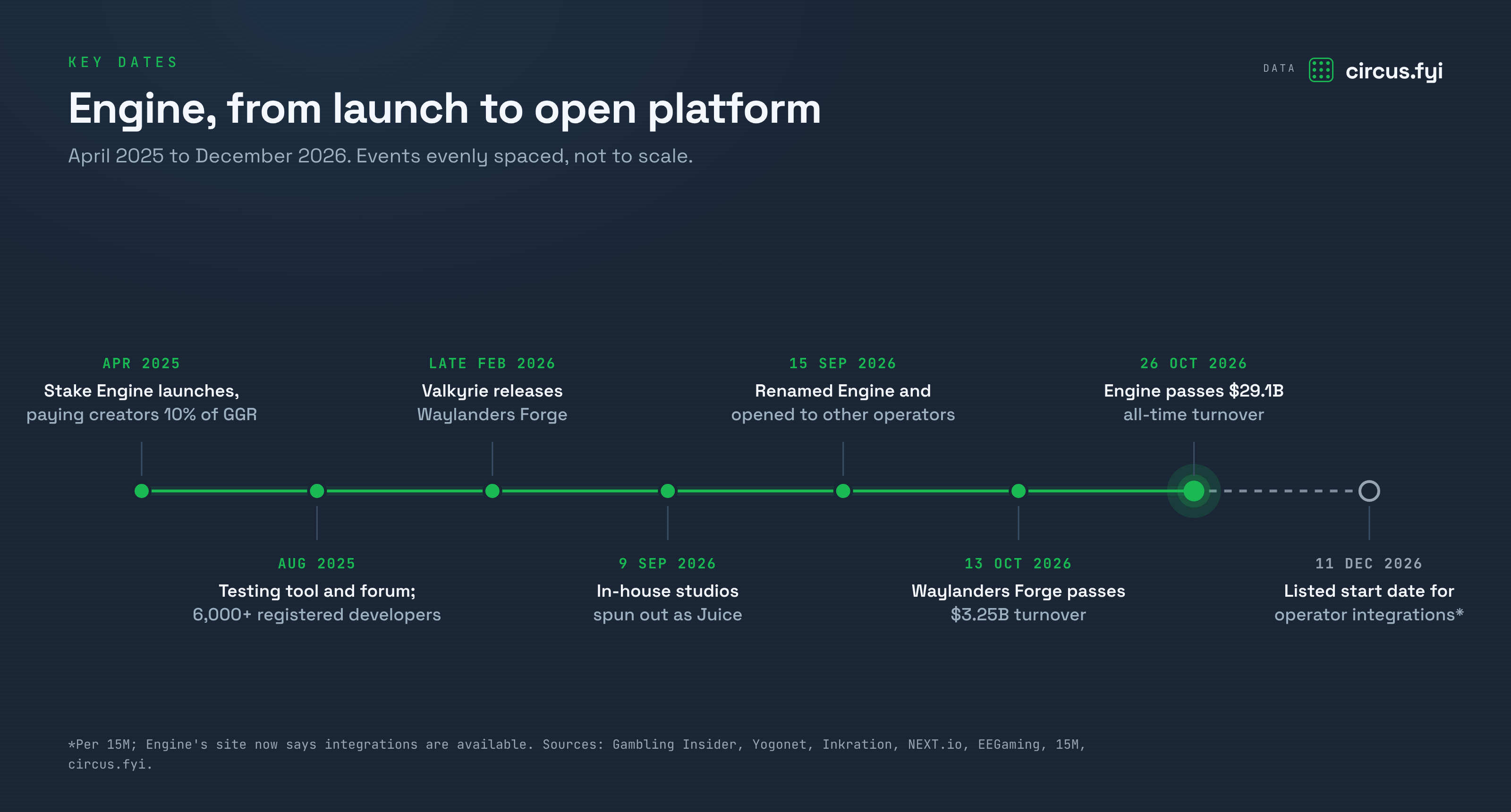
A slot called Waylanders Forge has taken $3.98 billion in bets on Engine (formerly Stake Engine), according to Circus data cut on 27 October 2026. That is one game, from one small studio, about eight months after its release at the end of February. It accounts for 13.6% of every dollar ever wagered on the platform.
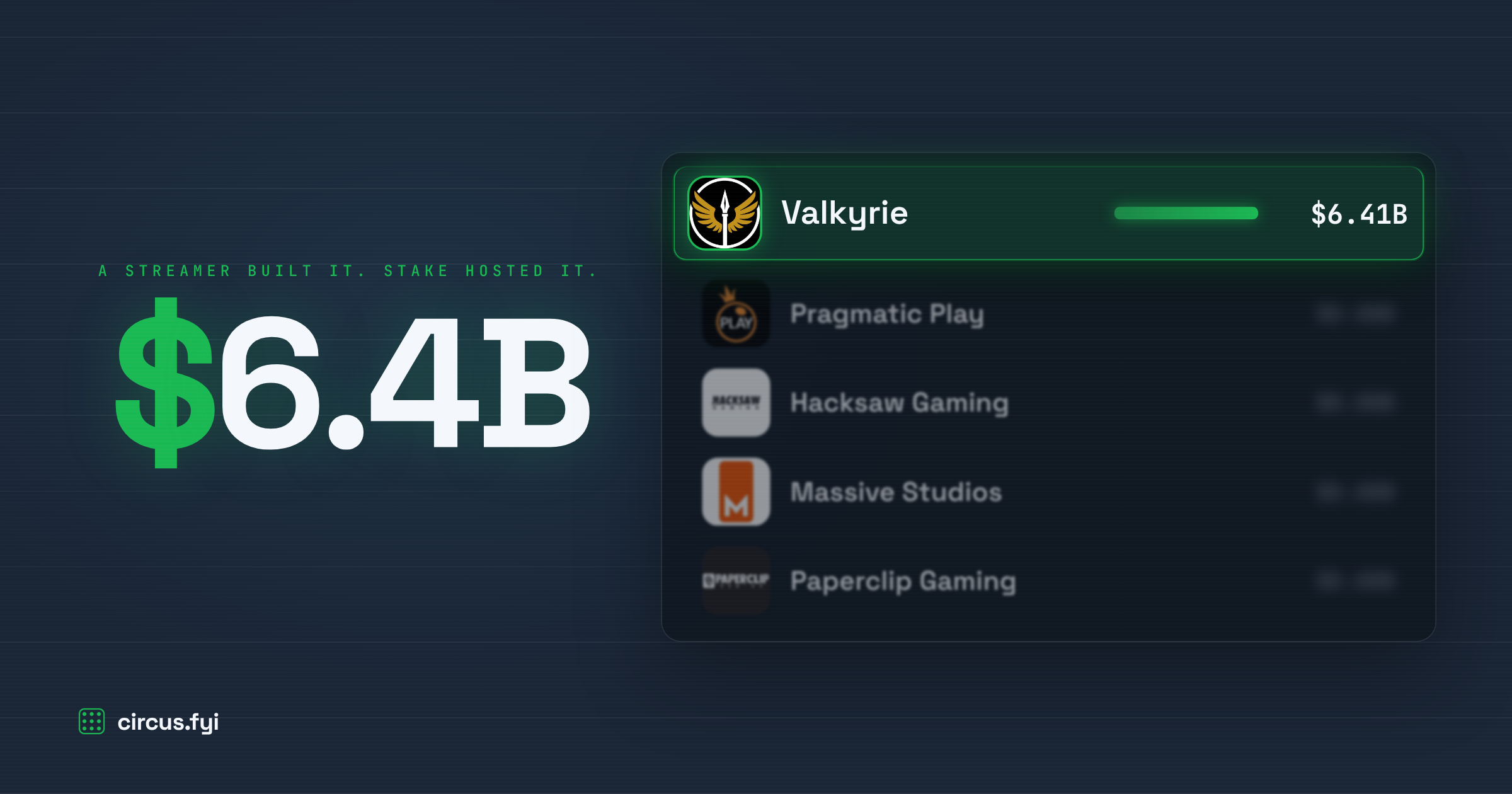
Its studio, Valkyrie, did $18.1 million of turnover on Engine in all of 2025. In September 2026 alone it did $1.23 billion, 40.7% of the whole platform.
The usual explanation for Engine is simple. Stake, whose 2024 gross gaming revenue was reported above $4.5 billion, was tired of paying fees to Pragmatic Play, Hacksaw Gaming and Nolimit City, so it built its own content machine and invited outsiders to fill it. Cheaper games, fatter margins.
The numbers do not support that story. On the rates Engine pays its exclusive creators, Stake saves little or nothing against what a top studio would charge, and on some assumptions it pays more. What it bought was something else: a lab it doesn't fund, a supply line it doesn't staff, leverage over the studios it still depends on, and, since September, a product it can sell to its rivals.
Key takeaways
- Engine has processed $29.13 billion of turnover from 12.64 billion bets across 6,179 games and 1,692 publishers, Circus data shows. Backing out play since mid-September gives about $24.5 billion, in line with Stake's own claims of $23–24 billion at the time.
- By our estimate, the house has won about $961 million on that turnover. Exclusive creators get 7.5–10% of that, depending on the payout model they choose; studios that also sell to other casinos get 5%. At a typical third-party rate of 6–9%, Stake could buy the same play from big studios for about the same, or less.
- Play is extremely concentrated. The top 10 studios hold 79.2% of all-time turnover. The 5,598 games outside Engine's ranked list share just 2.1%.
- In 2025, the in-house studios Stake has since spun out as Juice took 56% of Engine turnover. By October 2026 their share was 9.4%. Independents took over.
- Valkyrie went from 13th in 2025 to 1st, and has led every period Circus can measure this year. On Circus estimates it has earned about 29% of all creator income Circus can price.
- Streamer-owned studios now drive Engine. Valkyrie (ProdigyDDK), Donut Gaming (Foss) and Meta Gaming (Omie) together took about 48% of Engine turnover in September and October, up from a quarter all-time.
- Going non-exclusive halves a studio's royalty on Stake. For Valkyrie, that would have cost about $7.7 million on its all-time Stake numbers.
- Every figure here is play on Stake.com and Stake.us. No rival casino had been reported live on Engine by the data cut.
How studios get paid
Game studios don't sell slots. They rent them. A casino pays the studio a share of gross gaming revenue (GGR), the amount players lose on that studio's games after winnings. The share is the "take rate".
A worked example. Players stake $100 million on a slot with a 96% return to player (RTP). On average the casino keeps 4%, or $4 million of GGR. At a 10% take rate, the studio gets $400,000 and the casino keeps $3.6 million before its own costs. Turnover, the $100 million, is not revenue for anyone. It is the volume that revenue is skimmed from.
The take rate is rarely public. Hacksaw Gaming is one of the few studios to put a number in writing. Its IPO prospectus says a blended take rate in the mid- to high single digits is common across the industry. Secondary sources cite a wider band of roughly 7% to 20% of GGR, with lower rates for the largest operators. One aggregator lists NetEnt and Red Tiger at 11.5–13% outside Asia, a figure that includes its own markup.
Three things push the real number around. Volume tiers: an operator the size of Stake negotiates rates far below what a small casino pays. Aggregators: many operators reach studios through a middleman who adds a slice. And secrecy: no top studio publishes its operator-by-operator rates, because doing so would set a ceiling on every future negotiation. Pragmatic Play is private and publishes no accounts; SiGMA estimated its revenue at around $750 million in April 2025. Nolimit City, bought by Evolution in 2022 for €200 million upfront plus earn-outs, has never disclosed one either.
That leaves a working range. For a customer of Stake's size, the honest assumption is somewhere between 6% and 15%, with the bottom of that band more likely. Nobody outside the room knows Stake's actual rates with any studio, and this article doesn't claim to.
Engine launched in April 2025 with a simple pitch: build on our remote game server, and we pay you 10% of GGR, monthly. At launch it was reported to come with no exclusivity and no lock-ups. Ten per cent sits just above the mid-to-high single digits Hacksaw says is common.
The terms have since grown more detailed. Engine's creator documentation offers exclusive studios a choice of two models. One pays 10% of actual GGR; when players run hot and a game loses money, the shortfall is carried forward and paid off from later earnings. The other pays a guaranteed 7.5% of the GGR the game's maths says it should produce, so the studio carries no variance at all. Studios that also sell their games to other casinos receive 5% on Stake, HouseMoney has confirmed. That tier does not appear in the public documentation.
The math nobody ran
Start with what Circus measures. Engine publishes turnover and bet counts for its ranked games and studios, and it publishes the mathematical model behind each game, from which a house edge follows. Circus combines the two.
Across the games where Engine publishes the maths, turnover-weighted RTP is 96.70%, a house edge of 3.30%. Those games carry $22.64 billion of turnover, 79.4% of the ranked total, and an estimated house win of $752.9 million.
The other 20.6% is mostly one studio. Massive Studios, now part of Juice, has $4.59 billion of turnover and no published maths. Knucklehead Syndicate, another Juice studio, adds $199 million. If that unpriced turnover held at the same 3.30% edge, an assumption rather than a measurement, the house win on the full $29.13 billion platform is about $961 million. We use that as our GGR estimate, with $753 million as the floor.
Two cautions. This is theoretical hold: what the maths says the house should keep over a very large number of spins. Real results swing with luck, especially on games where a few huge wins drive the return. And it is house win before any royalty is paid, not Stake's profit.
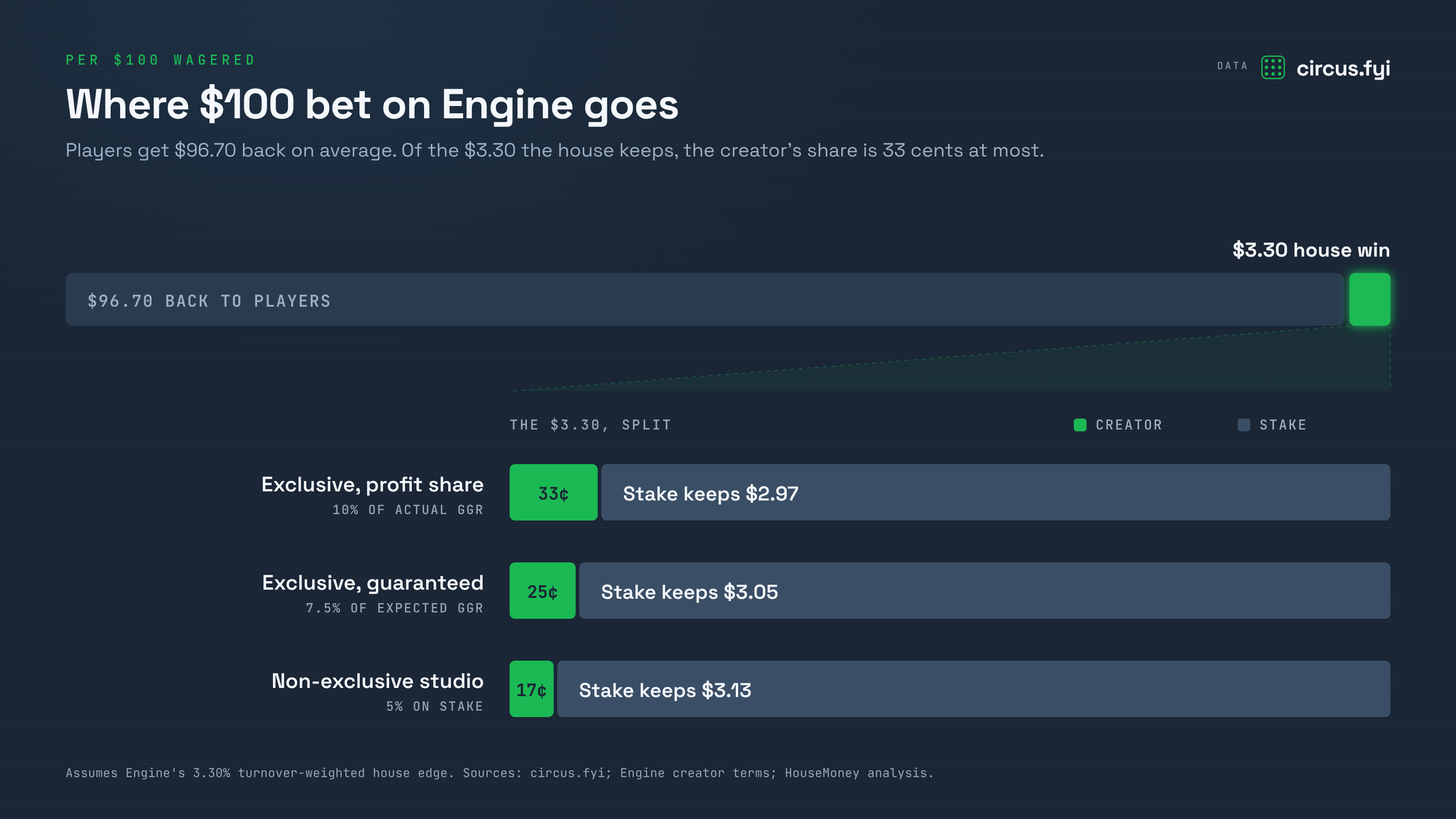
Stake's cut is the house win minus the creator's share. On the games Engine prices, Circus estimates it at about $700 million of the $752.9 million, or 93%, before Stake's own costs. The range is narrow whichever payout model studios pick: $697 million if every exclusive studio takes 10% of actual GGR, $706 million if they all take the guaranteed 7.5%. Put per bet, of every $100 wagered on an average Engine game, players get back $96.70. The house keeps $3.30, and the creator's share of that is 33 cents at most.
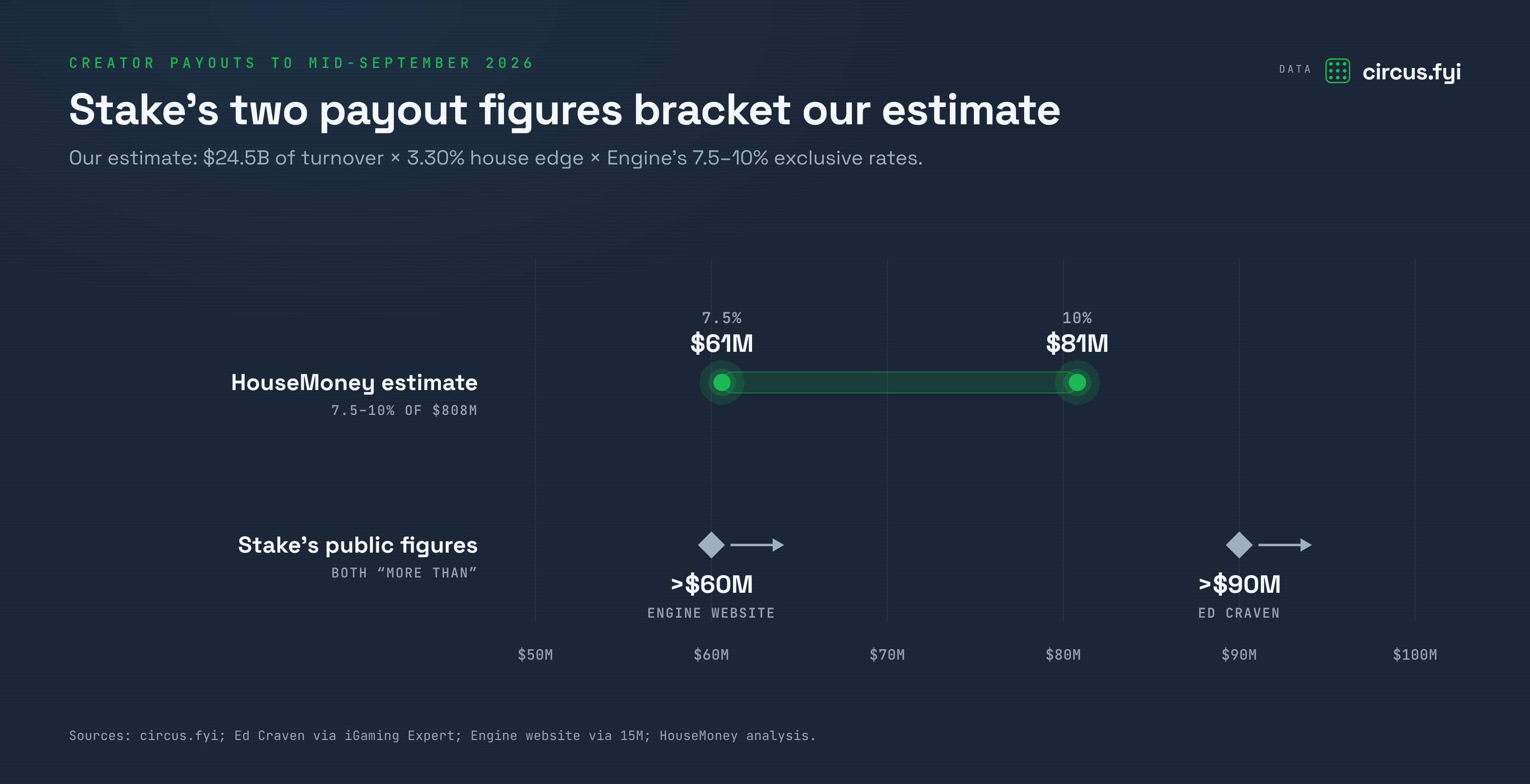
Now check that against Stake's own figures, which don't agree with each other. On 15 September, Ed Craven said Engine had paid more than $90 million to publishers. The next day, 15M reported that Engine's website showed more than $60 million paid. Circus puts turnover up to roughly that date at about $24.5 billion, close to Craven's $24 billion. At a 3.30% edge that is about $808 million of house win. Paid at 7.5–10%, the range Engine's exclusive payout models allow, creators would have earned $61 million to $81 million.
The two company figures bracket that range. The website number fits a platform where many creators chose the guaranteed 7.5%. Craven's fits if realised hold ran above theoretical, which happens when players lose more than the maths predicts, or if Massive Studios' unknown edge is above average. What neither figure supports is a platform built to pay creators less than the market. Through mid-September, Engine paid broadly what a big studio would charge.
Here is the royalty comparison on our full-platform GGR estimate, ordered by rate.
| Royalty model | Rate | Payout on $961M est. GGR | Payout on $753M priced GGR |
|---|---|---|---|
| Engine, non-exclusive studios | 5% | $48.1M | $37.6M |
| Third-party, low | 6% | $57.7M | $45.2M |
| Engine, blended on Circus's assignments | 7.38% | $70.9M | $55.6M |
| Engine, exclusive, guaranteed model | 7.5% of expected GGR | $72.1M | $56.5M |
| Third-party, Hacksaw "mid-to-high single digits" | 9% | $86.5M | $67.8M |
| Engine, exclusive, profit-share model | 10% | $96.1M | $75.3M |
| Third-party, mid | 12% | $115.4M | $90.3M |
| Third-party, high | 15% | $144.2M | $112.9M |
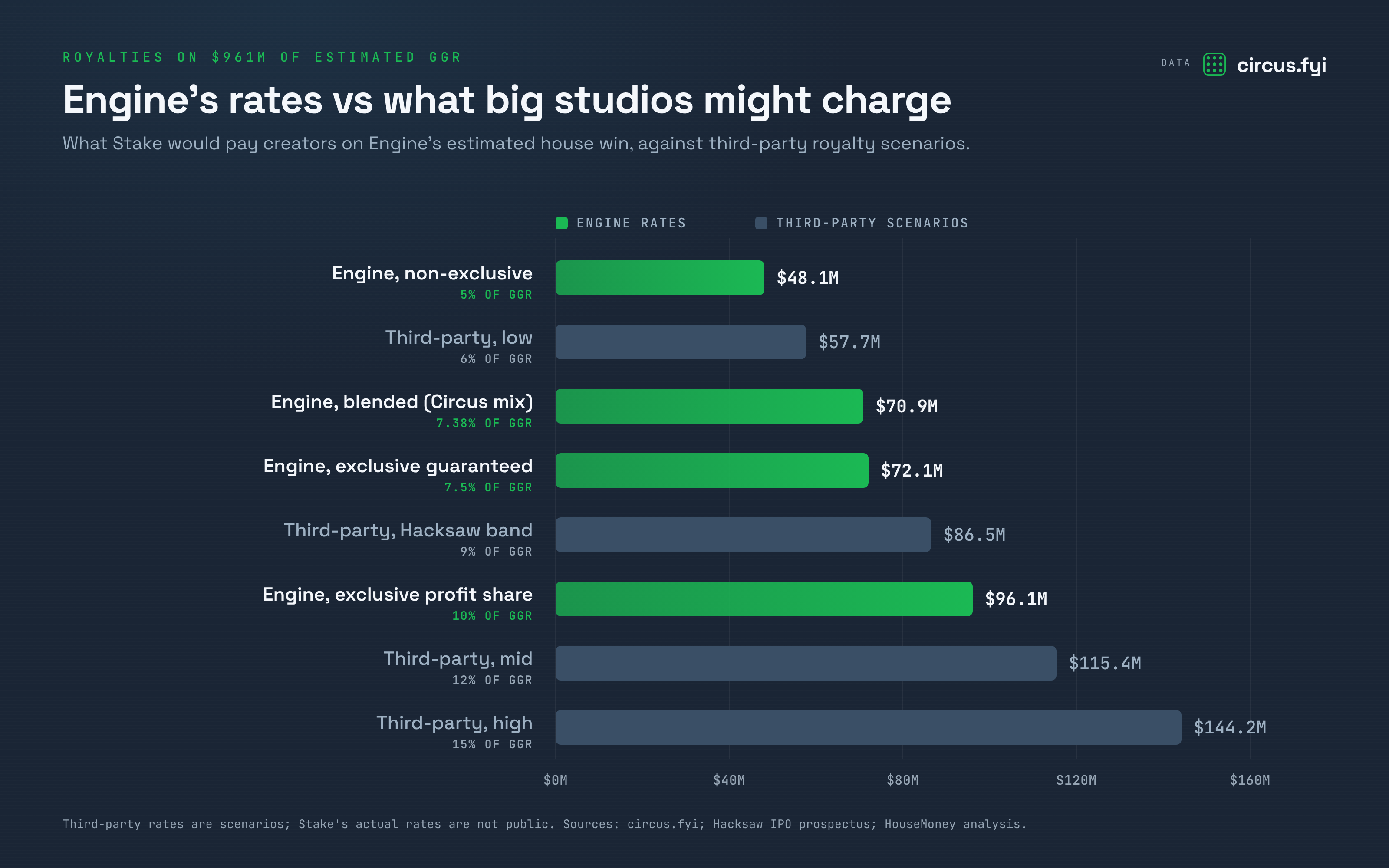
Read the table the way a buyer would. If Stake's real rates with the big studios sit in Hacksaw's band, an exclusive Engine game costs it anywhere from $14 million less to $38 million more than buying the same play from third parties, by our estimate. Only if it pays 12–15% does Engine save real money: $19 million to $72 million. There is no single savings figure, and anyone who quotes one is guessing at a rate that has never been published.
Only at 5% does Engine look cheap. On Circus's current assignments, $394.1 million of the $752.9 million priced house win, 52%, comes from studios modelled at 5%; the other $358.8 million is at 10%. So about half of Engine's GGR may now sit at a rate that undercuts any plausible third-party deal. But that rate applies only to studios that also sell elsewhere. The saving exists exactly where Stake has stopped being the only buyer.
What Engine actually looks like
Engine is big. Circus counts $29.13 billion of turnover, 12.64 billion bets, 6,179 games and 1,692 publishers. Stake's September press release said $23 billion and 9.7 billion bets; Craven said $24 billion the same day. Subtracting what Circus has recorded since mid-September gives about $24.5 billion and 10.2 billion bets, so Circus sits close to the higher company number. The company's "4,000+ games" and "1,000+ publishers" are lower bounds that have kept growing.
All of it is play on Stake's own sites. Engine's public data feed, which Circus reads, covers games played on Stake.com and its US sweepstakes site, Stake.us, according to independent trackers. No rival casino had been reported live on Engine by the data cut, so every share in this article is a share of play on Stake.
Engine doesn't publish monthly history, so Circus reconstructs four periods from the windows it does publish: launch to December 2025, January to August 2026, September, and 1–26 October. These periods cover the ranked games, $28.51 billion of the $29.13 billion total.
| Period | Turnover | Per month | Bets |
|---|---|---|---|
| Apr–Dec 2025 | $6.63B | $736M | 2.00B |
| Jan–Aug 2026 | $15.71B | $1.96B | 7.29B |
| Sep 2026 | $3.02B | $3.02B | 1.54B |
| Oct 1–26, 2026 | $3.15B | $3.75B pace | 1.71B |
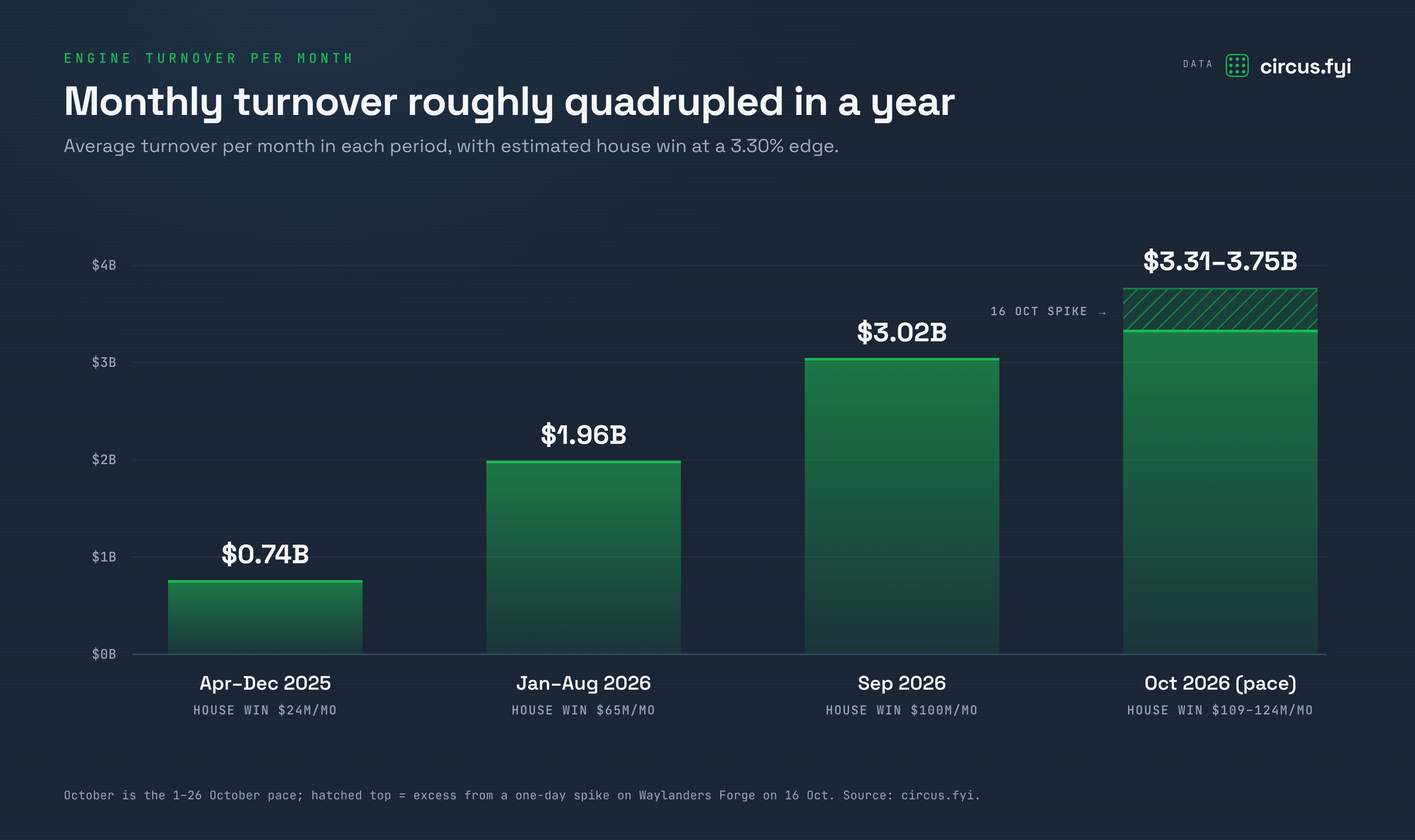
Monthly volume roughly quadrupled from the 2025 average to September. One caution on October: on 16 October, Waylanders Forge recorded $382 million of turnover from 2.9 million bets, against a typical $10–15 million a day. That is an average bet of about $130 against the game's usual $4–6. It may be one or a few very large players, or a reporting artefact. Excluding that one day's excess, October is running at about $3.31 billion a month, still about 10% above September.
The edge is thin and remarkably uniform. Of the 6,287 games in Engine's public catalogue, the median base-game RTP is 96.01%. Some 2,593 sit between 96% and 96.5%, and 1,827 between 95% and 96%. Only 182 are above 97%. The outliers are at the top of the chart: Waylanders Forge runs at 98% RTP, a 2% edge, and Valkyrie's catalogue averages 97.61%. Most of its rivals sit at 96%.
That gap matters for who makes the house money. Valkyrie has 28.3% of priced turnover but only 20.3% of estimated house win. Titan Gaming and Paperclip Gaming, with about half Valkyrie's turnover each, produce nearly as much: $137.3 million and $132.4 million of estimated house win against Valkyrie's $153.2 million. Candy Dash has 23% of Waylanders Forge's turnover and 46% of its estimated house win.
The top 10 games by turnover, with their rank by estimated house win:
| # | Game | Studio | Turnover | Bets | Avg bet | RTP | Est. house win | Studio share | Stake's est. cut | House-win rank |
|---|---|---|---|---|---|---|---|---|---|---|
| 1 | Waylanders Forge | Valkyrie | $3.98B | 656.7M | $6.05 | 98.00% | $79.5M | $8.0M | $71.6M | 1 |
| 2 | Candy Dash | Paperclip Gaming | $920.0M | 175.9M | $5.23 | 96.00% | $36.8M | $3.7M | $33.1M | 2 |
| 3 | Drac's Stacks | Massive Studios | $608.1M | 50.1M | $12.14 | Not published | ~$20.1M* | Not modelled | Not modelled | — |
| 4 | Hexappeal | Massive Studios | $603.1M | 42.8M | $14.08 | Not published | ~$19.9M* | Not modelled | Not modelled | — |
| 5 | Odins Vault | Valkyrie | $577.2M | 367.7M | $1.57 | 96.70% | $19.0M | $1.9M | $17.1M | 3 |
| 6 | Roosters Return | Massive Studios | $503.7M | 61.5M | $8.18 | Not published | ~$16.6M* | Not modelled | Not modelled | — |
| 7 | Waylanders Cup | Valkyrie | $411.1M | 92.2M | $4.46 | 96.70% | $13.6M | $1.4M | $12.2M | 6 |
| 8 | Puffer Stacks | Titan Gaming | $392.8M | 16.6M | $23.66 | 96.34% | $14.4M | $0.7M | $13.7M | 4 |
| 9 | Roosters Revenge | Massive Studios | $369.8M | 21.3M | $17.36 | Not published | ~$12.2M* | Not modelled | Not modelled | — |
| 10 | Dragonspire | Paperclip Gaming | $342.2M | 263.7M | $1.30 | 96.00% | $13.7M | $1.4M | $12.3M | 5 |
\Engine publishes no maths for Massive Studios. These figures assume the platform's 3.30% turnover-weighted edge and are excluded from the house-win ranking. Massive's royalty terms since the Juice spin-out are not public.*
Among priced games, places 7 to 10 by estimated house win go to Ganja Snail (Donut Gaming, $11.1M), Dojo Duel (Titan Gaming, $11.0M), Bank Basher (Twist Gaming, $9.8M) and Underworld (Titan Gaming, $7.7M). Massive Studios' games stand out for their bet size: $8 to $17 on average, against $2.30 across the whole platform, which points to a high-stakes audience.
The top 10 studios by turnover:
| # | Studio | Games | Turnover | Est. house win | Studio share (Circus rate) | Stake's est. cut | House-win rank | Turnover per game | Best game | Status |
|---|---|---|---|---|---|---|---|---|---|---|
| 1 | Valkyrie | 22 | $6.41B | $153.2M | $15.3M (10%) | $137.8M | 1 | $291.3M | Waylanders Forge | Stake-exclusive |
| 2 | Massive Studios | 44 | $4.59B | ~$151.5M* | Not modelled | Not modelled | — | $104.4M | Drac's Stacks | Part of Juice (spun out 9 Sep 2026) |
| 3 | Titan Gaming | 73 | $3.66B | $137.3M | $6.8M (5%) | $130.5M | 2 | $50.2M | Puffer Stacks | Circus models non-exclusive |
| 4 | Paperclip Gaming | 65 | $3.33B | $132.4M | $13.1M (10%) | $119.3M | 3 | $51.2M | Candy Dash | Circus models exclusive |
| 5 | Twist Gaming | 39 | $1.73B | $54.9M | $2.7M (5%) | $52.3M | 4 | $44.4M | Bank Basher | Part of Juice (spun out 9 Sep 2026) |
| 6 | Colorful Play | 41 | $952.3M | $37.0M | $3.6M (10%) | $33.5M | 5 | $23.2M | Sugar Rift 1K | Circus models exclusive |
| 7 | Uppercut Gaming | 37 | $847.7M | $33.9M | $1.6M (5%) | $32.3M | 6 | $22.9M | Phoenix 1000 | Circus models non-exclusive |
| 8 | Donut Gaming | 16 | $690.8M | $22.8M | $1.1M (5%) | $21.7M | 7 | $43.2M | Ganja Snail | Circus models non-exclusive |
| 9 | Terminal Games | 12 | $458.5M | $17.6M | $0.9M (5%) | $16.7M | 8 | $38.2M | Motherclucker | Circus models non-exclusive |
| 10 | Degen Lab | 8 | $383.5M | $13.7M | $1.3M (10%) | $12.5M | 9 | $47.9M | Keno Xtreme | Circus models exclusive |
\Assumes the platform's 3.30% edge; Engine publishes no maths for Massive Studios. On that assumption Massive would rank second by house win, just behind Valkyrie, because its players bet far bigger stakes.*
Pocket Play completes the priced house-win top 10 at $12.1 million ($0.9 million to the studio, $11.1 million to Stake).
Then there is concentration, which is the defining feature of Engine.
| Share of all-time turnover | Games | Studios |
|---|---|---|
| Top 1 | 13.6% | 22.0% |
| Top 5 | 22.9% | 67.7% |
| Top 10 | 29.9% | 79.2% |
| Top 50 | 51.6% | — |
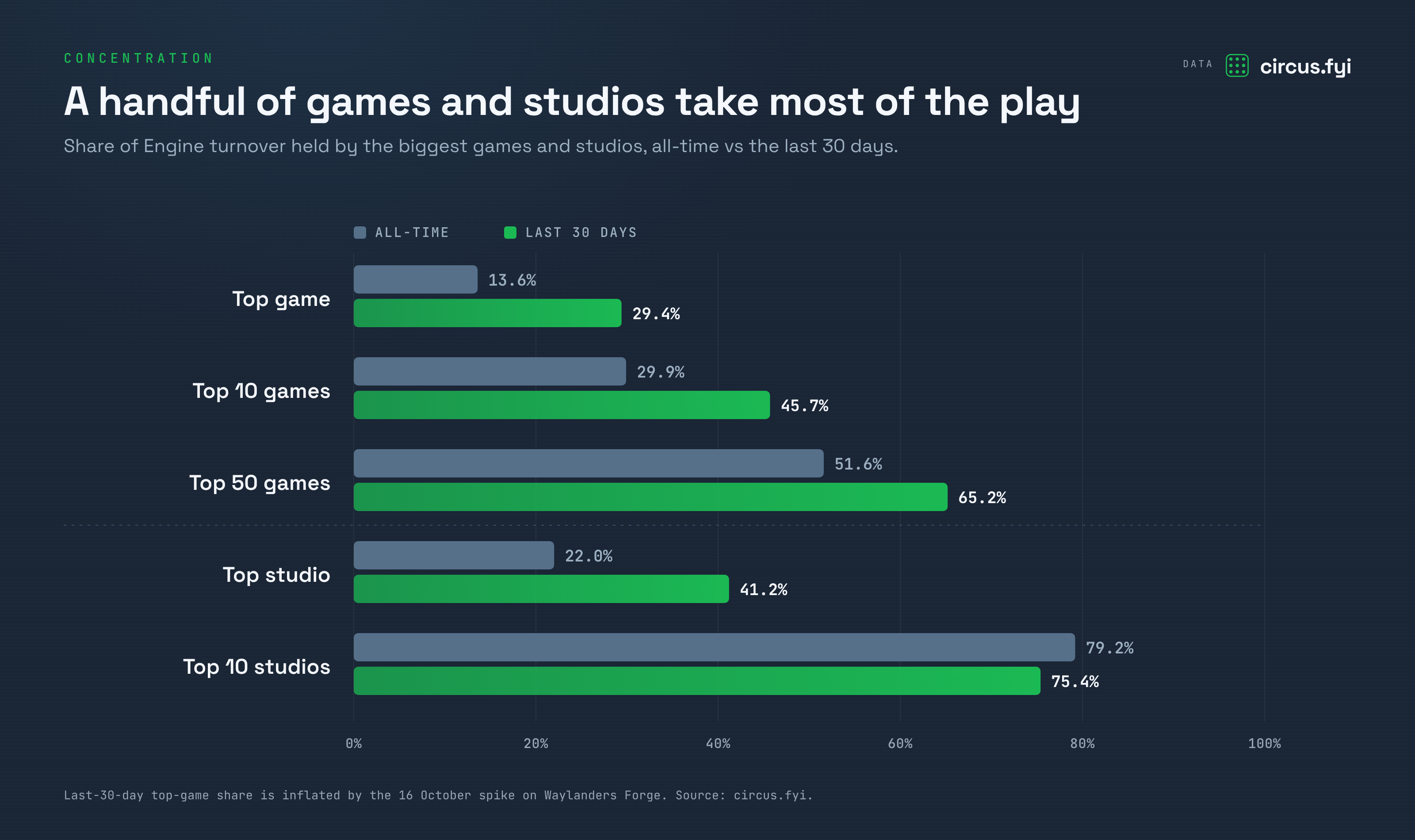
The last 30 days are more concentrated still, though the 16 October spike inflates the top-game figure. Engine's ranking covers 581 games, each with at least $468,000 of turnover. Together they hold 97.9% of all-time volume. The other 5,598 games share $616 million, about $110,000 each on average. Only 45 games have passed $100 million and only one has passed $1 billion. Among studios, five have passed $1 billion and 23 have passed $100 million.
So does the creator economy pay? For a small group, very well. Circus estimates studio earnings by applying its 10% or 5% assumption to each game's house win. Across the 84 studios it can price, those estimates total $52.9 million. Exclusive studios on the guaranteed 7.5% model would earn a quarter less than Circus assumes. Valkyrie alone has 28.9%. The top 10 have 89.3%. Eight studios have passed $1 million; 22 have passed $100,000. The median priced studio has earned about $34,000. Most of Engine's 1,692 publishers are not in the ranking at all, and on these numbers earn very little. Engine is less a creator economy than a talent search with a small prize pool for most and a jackpot for a few.
Circus does not classify games by type, so it can't split turnover between slots, crash, plinko-style and card games. Nor does it record release dates, so release cadence relies on Stake's claim of 250+ new titles a week.
From giants to indies
Stake does not publish what share of its slot play goes to Pragmatic Play, Hacksaw or Nolimit City, and Circus doesn't track non-Engine providers on Stake. So the "before" picture has to come from the one primary source that touches it.
Hacksaw's 2025 year-end report says its largest customer was 20% of GGR in the fourth quarter of 2024 and 13% a year later. Hacksaw does not name that customer. Analysts widely believe it is Stake, and Ed Craven is reported to own about 4% of Hacksaw. If it is Stake, the drop fits a shift of play towards Engine. It also fits Hacksaw simply growing faster elsewhere: its 2025 revenue reached €197.5 million. The data allows both readings.
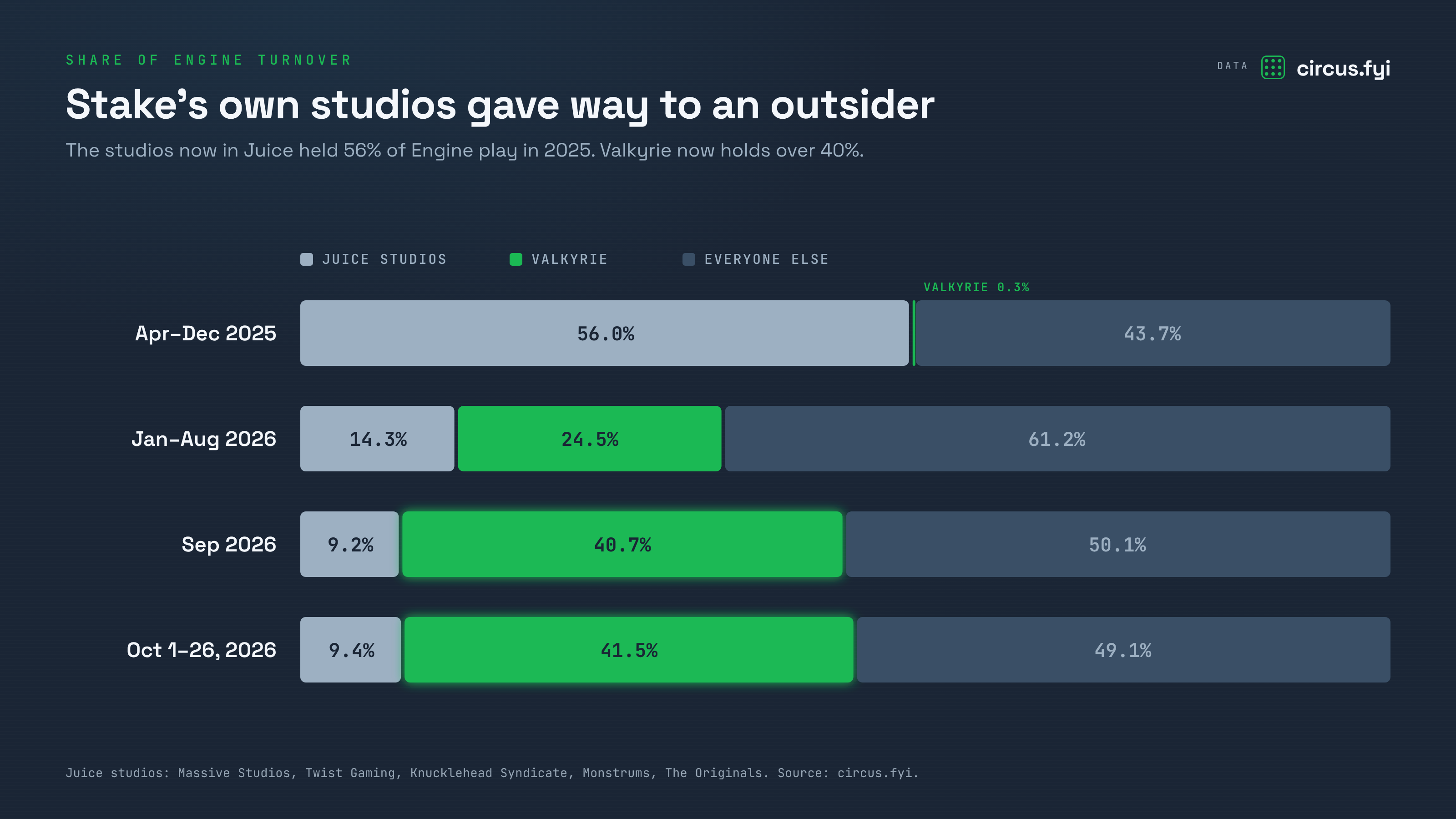
Inside Engine, the shift is unambiguous, and it is not the one most people assume. In 2025, Engine's biggest studios were Stake's own, the ones now grouped under Juice. Massive Studios took 48.4% of all Engine turnover that year. Add Twist Gaming and Knucklehead Syndicate, and the studios now in Juice held 56.0%.
Then the outsiders arrived.
| Period | Juice studios' share | Valkyrie's share |
|---|---|---|
| Apr–Dec 2025 | 56.0% | 0.3% |
| Jan–Aug 2026 | 14.3% | 24.5% |
| Sep 2026 | 9.2% | 40.7% |
| Oct 1–26, 2026 | 9.4% | 41.5% (33.7% excl. 16 Oct) |
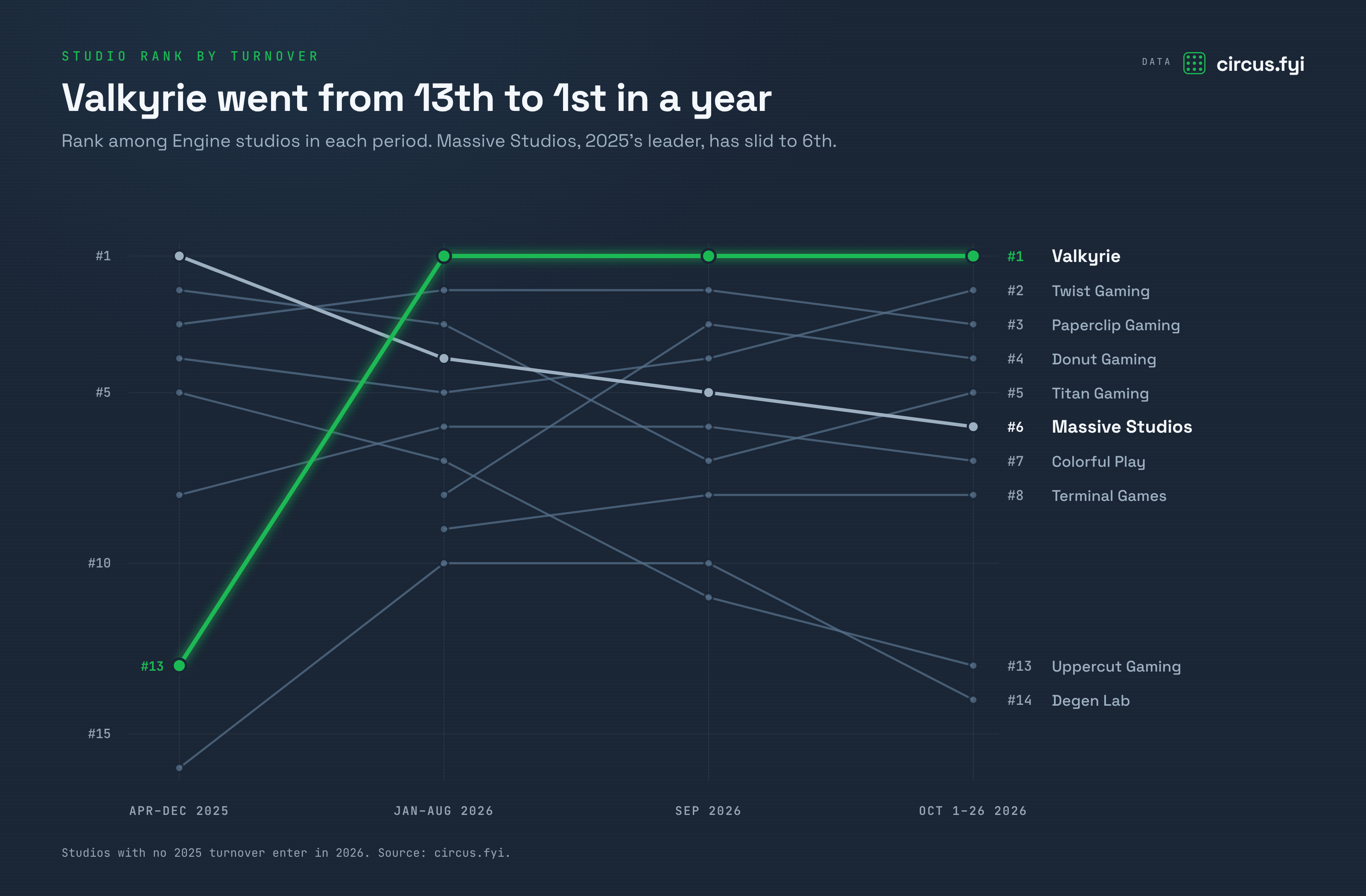
The rank table tells the same story.
| Studio | 2025 | Jan–Aug 2026 | Sep 2026 | Oct 2026 |
|---|---|---|---|---|
| Valkyrie | 13 | 1 | 1 | 1 |
| Massive Studios | 1 | 4 | 5 | 6 |
| Titan Gaming | 2 | 3 | 7 | 5 |
| Paperclip Gaming | 3 | 2 | 2 | 3 |
| Twist Gaming | 4 | 5 | 4 | 2 |
| Colorful Play | 8 | 6 | 6 | 7 |
| Uppercut Gaming | 5 | 7 | 11 | 13 |
| Donut Gaming | — | 8 | 3 | 4 |
| Terminal Games | — | 9 | 8 | 8 |
| Degen Lab | 16 | 10 | 10 | 14 |
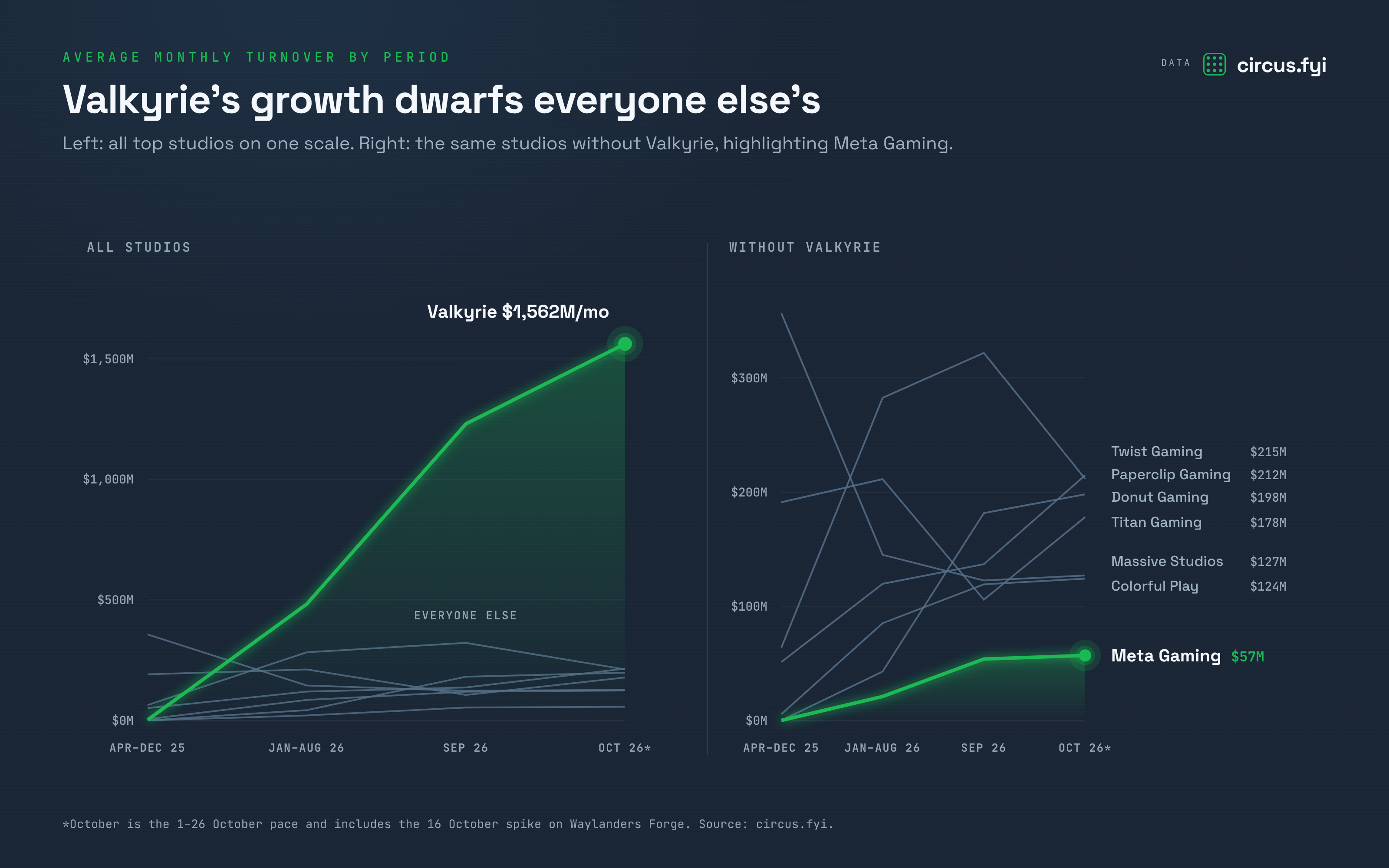
Valkyrie. SiGMA describes it as a studio active since 2025, building Engine slots as Stake and Stake.us exclusives. On Engine it did $18.1 million of turnover in 2025. Then came Waylanders Forge at the end of February 2026. Valkyrie's development partner reported $3.25 billion of turnover and 616 million bets by 13 October, about 12% of Engine. Circus now shows $3.98 billion and 657 million bets, 13.6% of the platform. The difference is two weeks of play, including the 16 October spike.
Valkyrie's catalogue now totals $6.41 billion, 22.0% of everything Engine has ever processed, at $291 million per game. That's nearly six times the per-game turnover of Titan or Paperclip, each about $50 million. Waylanders Forge is 62% of the studio's total, but Valkyrie is not a one-hit studio. Odins Vault ($577 million), Waylanders Cup ($411 million), Red Strike ($220 million), Angel of Asgard ($192 million) and Captain Death ($181 million) would each be a career-defining game for most publishers. From January to August, Valkyrie did $3.86 billion; in September and October it did more than $1.2 billion a month.
Its edge is the lowest of any major studio. Waylanders Forge and Lokis Vault run at 98% RTP; the catalogue averages 97.61%. Players get more back, so the house keeps less per dollar. On Circus estimates, Valkyrie has still earned about $15.3 million, the most of any studio.
Meta Gaming. Owned by the streamer Omie, Meta Gaming arrived on Engine in 2026, with Coins and Cauldrons as its debut slot. It launched as a Stake exclusive; HouseMoney understands it has since gone non-exclusive, and Circus models it at the 5% rate. Circus shows 14 games and $269.4 million of turnover, nothing before 2026, then $167.9 million from January to August, $53.7 million in September and $47.8 million in the first 26 days of October. That puts it 13th all-time and 11th over the last 30 days, with 1.5% of recent turnover. Its biggest games are Steel vs Shadow ($47.9 million) and Mushroom Madness ($46.7 million); Coins and Cauldrons has $33.8 million. Its turnover is spread across a family of games rather than one hit, which suggests a studio building an audience more than chasing a breakout.
Engine's own announcement of its opening named streamers alongside developers and studios as the creators it wants to attract. That is already happening. Several of Engine’s fastest-rising studios are owned by streamers: Valkyrie by ProdigyDDK, Donut Gaming by Foss, Meta Gaming by Omie and Butter by Rydurz. The three with Circus data, Valkyrie, Donut Gaming and Meta Gaming, took 48.5% of Engine turnover in September and 48.3% in the first 26 days of October. All-time, they hold 25.3%. In under a year, streamer-owned studios have gone from a sideshow to roughly half of Engine’s play.
The advantage is structural. A studio with a built-in audience can launch to thousands of players on day one, show a new game live, and see within hours which features players love. That shortens the feedback loop that a traditional studio runs through focus tests and staggered roll-outs. It also raises a fair question for any studio where a promoter has a financial interest in a game: whether audiences are told. Where such ties exist, they should be disclosed on stream. We make no claim about these two studios.
Other risers fit the same pattern. Donut Gaming, owned by the streamer Foss, had no Engine turnover in 2025 and was 3rd in September. Ganja Snail ($337.5 million all-time) is almost half its total. Terminal Games went from nothing to 8th. Coreffect Interactive climbed from 26th in September to 9th in October. Evoslot ranks 20th all-time but 10th over the last 30 days. On the way down: Uppercut Gaming, 5th in 2025 and 13th now, and Massive Studios, from 1st to 6th.
What Stake really got
If Engine is not a cost-cutting machine, what is it?
First, a free research lab. About 1,700 publishers carry the cost and risk of building games. Stake hosts and distributes them, pays only on what players lose, and pays nothing for the thousands of games that fail. On Circus data, 5,598 games share 2.1% of turnover. For Stake those are failed experiments that cost nothing.
Second, a supply line. Stake says Engine ships more than 250 new titles a week. No traditional studio, and no group of them, ships at that rate. Breadth on that scale keeps a lobby fresh in a way no supplier contract can.
Third, leverage. Whatever Stake pays Pragmatic, Hacksaw or Nolimit, those negotiations now happen with a credible alternative on the table. A single Engine game took 13.6% of the platform's all-time turnover. A buyer that can grow a Waylanders Forge from scratch in eight months is a harder customer to raise prices on. Hacksaw's largest-customer share fell from 20% to 13% in a year. If that customer is Stake, as is widely believed, the fall fits that leverage at work, though Hacksaw's own growth could explain it equally well.
Fourth, cheaper content where it can get it. Studios that sell beyond Stake get 5% on Stake. On Circus's assignments that may already cover about half of Engine's house win. At 5%, Engine undercuts any plausible third-party rate. At 7.5–10%, it doesn't.
And fifth, the one that changes the business: a product. Content that Stake once only bought, it now sells.
The B2B game changer
On 9 September 2026, Stake's in-house studios, including Massive Studios and Twist Gaming, were spun out as Juice, a B2B supplier led by Brais Pena, formerly Easygo's head of strategy. Juice said it launched with more than 100 games that had generated over $12 billion of turnover as Stake exclusives. Roobet was the first operator to sign. Easygo's ownership stake in Juice has not been disclosed.
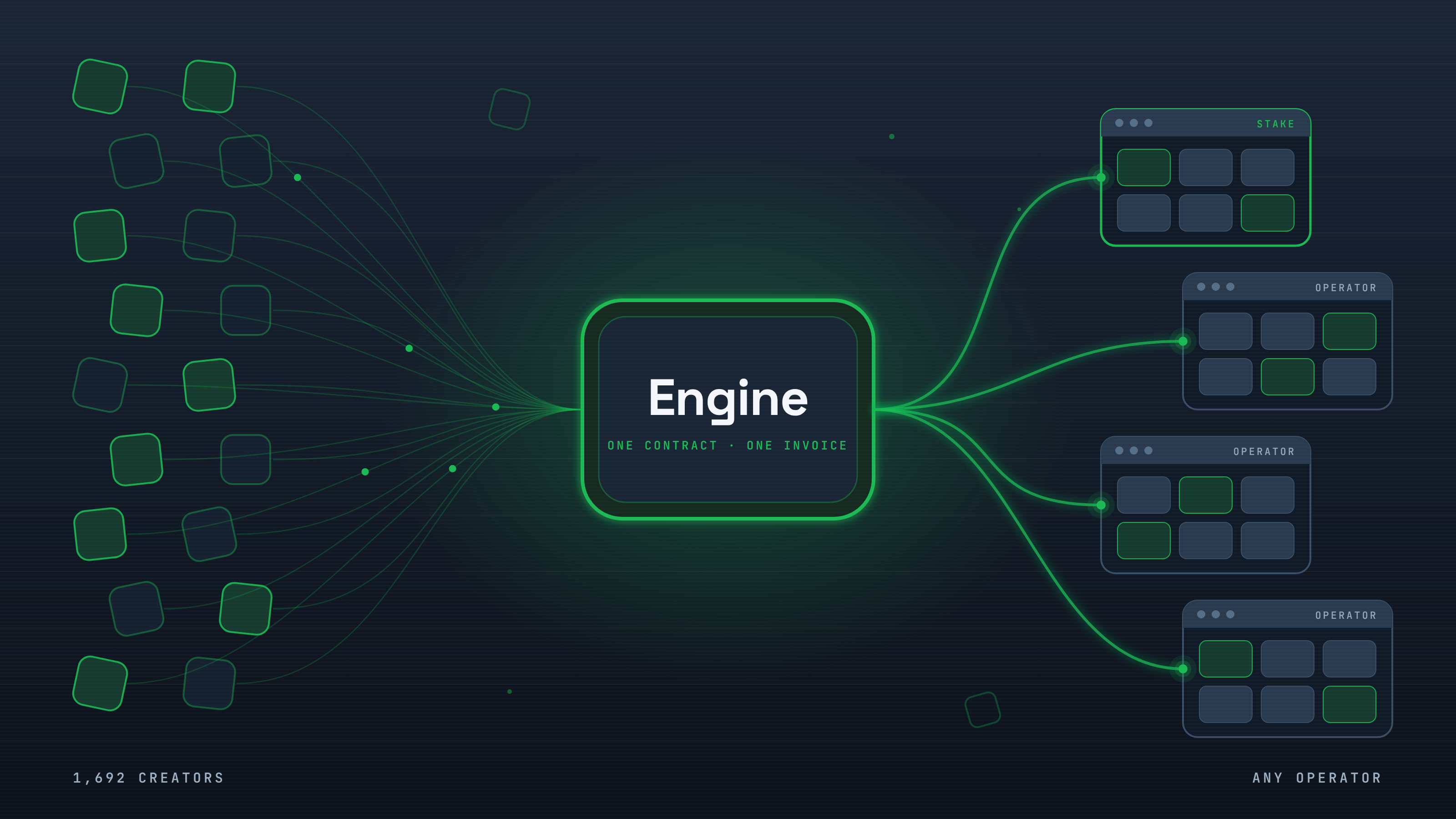
Six days later, Stake Engine was renamed Engine and opened to all operators. Operators sign one standard contract and receive one monthly invoice, and they keep what the company called "the substantial majority" of revenue. The exact operator split has not been disclosed.
Circus shows what Juice brings to Engine. The five Juice studios Circus can identify, Massive Studios, Twist Gaming, Knucklehead Syndicate, Monstrums and The Originals, have $6.53 billion of all-time Engine turnover, 22.4% of the platform, against the $12 billion Juice claims. The gap is large. It may reflect turnover from before Engine, play on other platforms, or a different definition of turnover. We can't reconcile it from public data.
The spin-out has not yet shown up as a change in Engine volume. Juice studios did $277 million in September and $297 million in the first 26 days of October. Twist Gaming is the one gaining: $136.8 million in September, $180.1 million in October, now 2nd over the last 30 days. Massive Studios continues its long decline. Knucklehead Syndicate fell from $14.2 million to $6.2 million. Monstrums ($2.0 million in October) and The Originals ($2.0 million) are small.
The same goes for Engine's opening. In mid-September, 15M reported that Engine listed 11 December as the start date for operator integrations; Engine's website now says integrations are available. Either way, rival casinos' play is not in the feed Circus reads, and none had been reported live by our data cut. It is too early to measure what opening the platform has done.
The two-tier split. Engine now pays creators on two tiers. Studios that stay exclusive to Stake get 10% of GGR on Stake, or the guaranteed 7.5% if they choose it. Studios whose games are also sold to other casinos get 5% on Stake. Both groups build on the same tools, and their games sit side by side in the same lobby.
The contract behind it ties creators closely to Stake. A sample licence agreement on Engine's creator documentation names Medium Rare N.V., the Curaçao company that operates Stake, as the counterparty. Creators license the rights in their games to it for 36 months, renewing automatically, and the agreement includes a right of first offer. It sets the fee on GGR from games activated on sites that Medium Rare or Engine own or operate. It does not say what creators earn when a rival casino runs their game.
The design is clever. A studio's best customer is almost certainly Stake, the platform's home and biggest audience. Going wide halves its royalty there. So only studios confident of winning real share elsewhere will leave, and the ones Stake most wants to keep, the hit-makers, have the most to lose. Meanwhile every studio that does go wide makes Stake the distributor of its games to rivals, and a cheaper buyer of them at home.
The creator's dilemma. A studio on the 10% model that goes wide gives up five points of its Stake GGR; one on the guaranteed 7.5% model gives up two and a half. To break even, its royalties from other casinos must replace that. Operator-side terms are not public, so the table shows what rival-casino GGR a studio on the 10% model would need under three labelled scenarios, using each studio's all-time estimated Stake house win.
| Studio | Est. Stake house win (all-time) | Royalty at 10% | Royalty at 5% | Given up by going wide | Rival GGR needed if rivals pay 5% | …if 10% | …if 15% |
|---|---|---|---|---|---|---|---|
| Valkyrie | $153.2M | $15.3M | $7.7M | $7.7M | $153.2M | $76.6M | $51.1M |
| Titan Gaming | $137.3M | $13.7M | $6.9M | $6.9M | $137.3M | $68.6M | $45.8M |
| Paperclip Gaming | $132.4M | $13.2M | $6.6M | $6.6M | $132.4M | $66.2M | $44.1M |
| Twist Gaming | $54.9M | $5.5M | $2.7M | $2.7M | $54.9M | $27.5M | $18.3M |
| Colorful Play | $37.0M | $3.7M | $1.9M | $1.9M | $37.0M | $18.5M | $12.3M |
| Uppercut Gaming | $33.9M | $3.4M | $1.7M | $1.7M | $33.9M | $17.0M | $11.3M |
| Donut Gaming | $22.8M | $2.3M | $1.1M | $1.1M | $22.8M | $11.4M | $7.6M |
| Terminal Games | $17.6M | $1.8M | $0.9M | $0.9M | $17.6M | $8.8M | $5.9M |
| Degen Lab | $13.7M | $1.4M | $0.7M | $0.7M | $13.7M | $6.9M | $4.6M |
| Pocket Play | $12.1M | $1.2M | $0.6M | $0.6M | $12.1M | $6.0M | $4.0M |
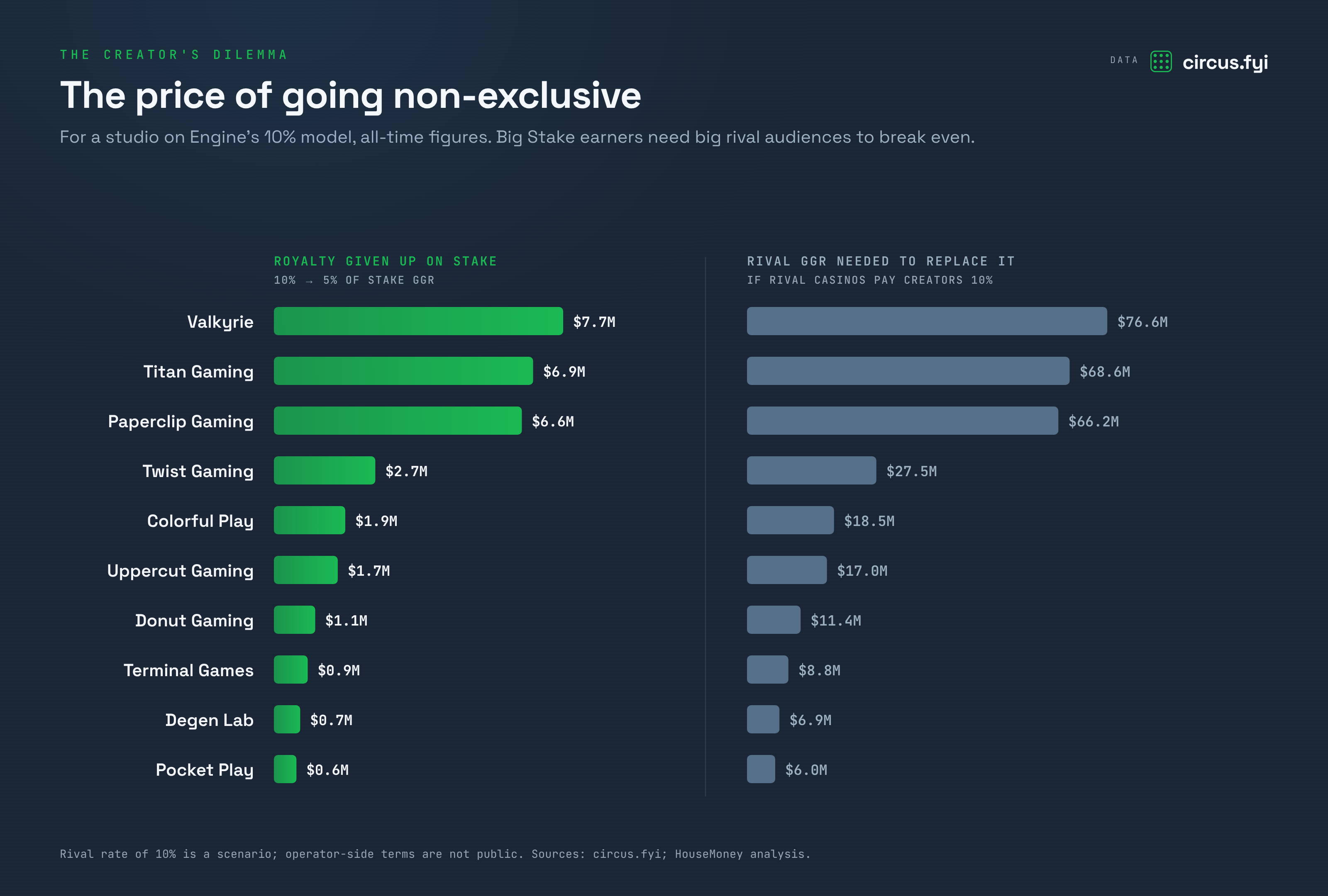
The rule of thumb is stark. If rivals pay creators the same 5% Stake would, a studio needs rival casinos to generate as much GGR on its games as Stake does, every period, to stand still. If rivals pay 10%, it needs half of Stake's GGR. Few rival casinos are likely to match Stake's slot audience, so for a studio like Valkyrie that is a high bar. For a small studio with modest Stake numbers, the arithmetic is easier: a few rival operators could plausibly replace a few hundred thousand dollars, and the exposure to new audiences may be worth more than the royalty points.
Exclusivity status for most studios is not public. Circus models seven studios at 10%: Valkyrie, Paperclip Gaming, Colorful Play, Degen Lab, Pocket Play, Black Coffee Studios and Knockout Labs. It models the rest at 5%. These are Circus's working assumptions, not Engine's records.
What rivals get, and what they risk. An operator signing up to Engine gets hundreds of new games a week, proven hits, one contract and one invoice. It also gets a supplier that is its biggest competitor. Stake sees what plays well on its own site first. It can keep its best studios exclusive, and the split gives it the tool to do so. And Engine's operator terms, which decide how much of every rival's GGR flows back to Easygo, have not been published.
What it means and what is still unknown
For traditional studios, Engine is a pricing problem more than a volume problem. The big names still supply the bulk of the world's slot play, but Stake can now show that an outside studio, with no sales team and no aggregator, can take over a fifth of its in-house platform within a year. That number will be in the room at every rate negotiation.
For aggregators, Engine is a direct threat. Its pitch to operators is aggregation without the middleman: one contract, one invoice, thousands of games.
For rival operators, the trade-off is speed against dependence. Engine is the fastest way to a fresh lobby, and it puts their content supply in the hands of the market leader.
For creators, Engine is the most open route to market the industry has had, and the most winner-takes-most. The top 10 studios hold 79.2% of all-time turnover. The median studio Circus can price has earned about $34,000.
Open questions remain:
- What share of Juice does Easygo own, and on what terms does Juice sell into Engine?
- What do operators actually pay Engine, and what share reaches creators on rival sites?
- When did the 5% tier take effect, and does it apply to actual or expected GGR?
- How will regulators treat games built by small, often anonymous creators once they reach licensed markets? Stake itself is licensed in Curaçao and is not available in markets such as the UK and US.
- Will rivals trust Stake as a supplier once it controls both the store and the shelf?
The numbers say Engine was never mainly about saving money. It was about owning the pipeline. As of September, Stake is selling it.
Methodology
Engine data is from Circus, which reads the turnover, bet counts and game maths Engine publishes. Engine's public feed covers games played on Stake.com and Stake.us; it contains no data from other operators. All figures run to 26 October 2026 (data cut 27 October, 01:23 UTC).
Engine publishes ranking windows rather than monthly history. Periods were derived by subtracting windows (all-time, this year, last month, this month). Studio and game rankings list roughly 550–610 entries per window; anything below the cut-off is counted as zero, so the four periods sum to $28.51 billion, the ranked share of the $29.13 billion total.
"Estimated house win" is turnover multiplied by the house edge implied by Engine's published base-game RTP (one minus RTP). It is theoretical hold before any creator royalty, not Stake's reported earnings. Engine publishes no maths for 20.6% of ranked turnover, mostly Massive Studios ($4.59 billion) and Knucklehead Syndicate ($199 million). Our $961 million full-platform estimate assumes all unpriced turnover runs at the platform's turnover-weighted edge of 3.30%.
"Stake's estimated cut" is estimated house win minus Circus estimated studio earnings, before Stake's own costs. "Circus estimated studio earnings" apply Circus's revenue-share assumptions (10% for seven studios, 5% for the rest) to each game's estimated house win. Exclusive studios can instead choose a guaranteed 7.5% of expected GGR, so for them Circus's estimate is an upper bound. The blended rate weights Circus's assumptions by estimated house win.
Break-even and royalty scenarios are our calculations. Stake's turnover, bet, game, publisher and payout figures are company claims. Third-party royalty rates are ranges, not Stake's actual rates.
Sources
- Circus, Engine studio and game data (circus.fyi), data cut 27 October 2026
- Engine public game catalogue (fair.stake-engine.com)
- Engine (engine.io)
- Stake Engine creator docs: payout models
- Stake Engine creator docs: game licence terms (sample)
- Gambling Insider: Stake introduces Stake Engine for game developers
- iGaming Expert: Stake to open Engine for external games distribution
- 15M: Stake opens Engine game network to other casino operators
- EEGaming: Stake rebrands Stake Engine as Engine
- Yogonet: Engine opens creator platform to wider iGaming market
- Yogonet: Stake Engine opens platform to over 6,000 developers
- NEXT.io: Stake game studios spin out as Juice
- iGB: Introducing Juice
- Engine Players: data source and coverage
- Hacksaw AB IPO prospectus, 16 June 2025
- Hacksaw year-end report 2025
- Yahoo Finance: Hacksaw Gaming growth
- SiGMA: Pragmatic Play revenue estimate
- Evolution: agreement to acquire Nolimit City
- Gambling Industry Jobs: how gambling companies make money
- Fuzz Gaming: game providers
- Sharpr: Stake wants to be the Apple of casino games
- SiGMA: Valkyrie Studio
- Inkration: Waylanders Forge hits #1 on Stake Engine
- Roshtein: Meta Gaming
- iGaming Express: Easygo reports A$257M profit


